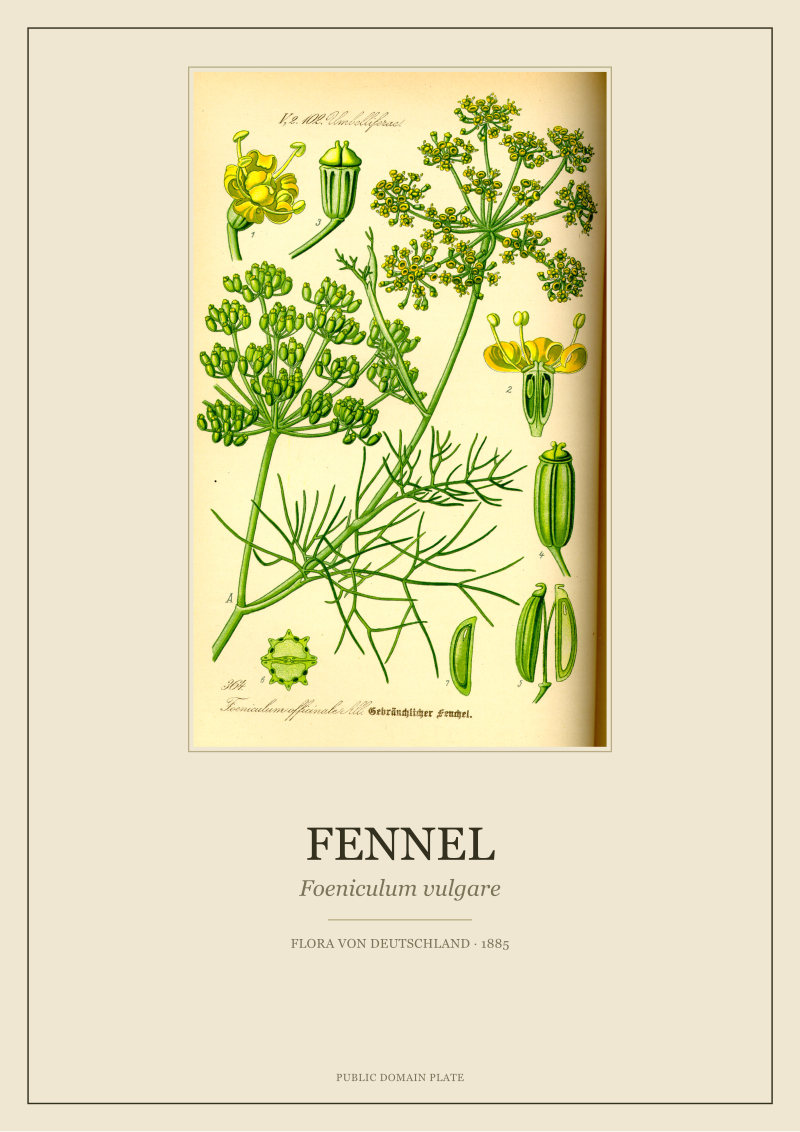
On a damp February afternoon in 2024, a reader wrote to the studio asking whether we sold a rose plate — specifically, something she could print at A2 and hang above a Georgian fireplace in a flat in Clapham. We did not. What we restore are the plates O.W. Thomé drew for Flora von Deutschland, Österreich und der Schweiz in 1885: Matricaria chamomilla, Hedera helix, Centaurea cyanus, Foeniculum vulgare. No roses. Her question stayed with us. "Rose pictures to print" is one of the most-typed phrases on the botanical web, and the honest answer runs through four centuries of printed roses, three price traps nobody warns you about, and one unglamorous final number.
1597: Gerard's Herball and the First English Rose Woodcuts
The first serious roses an English reader could pin to a wall came out of a book nobody meant to pin anything from. John Gerard's Herball, or Generall Historie of Plantes appeared in London in 1597, printed by John Norton, and it ran to roughly 1,480 pages of folio paper. Gerard was a barber-surgeon with a garden in Holborn; the book was less a work of original scholarship than a reorganisation of continental sources, and the woodcuts were largely borrowed from a stock originally cut for Jacob Theodor Tabernaemontanus's herbal in Frankfurt. The roses in Gerard — the eglantine, the damask, the "wilde brier" — appear as compact, black-and-white blocks. The line is sturdy. The modelling is almost absent. A woodcut rose is not a portrait; it is a sign.
That matters for the price question. The woodcut survived four centuries because it was built to. Pear-wood blocks, printed in relief, could run through a hand press thousands of times before the detail blurred. The cost of a Gerard-era rose, when the volume was new, was absorbed into the folio. The cost today is near zero: the Herball is comprehensively public domain, and major libraries have scanned it. What you cannot do is enlarge a Gerard rose to A2 and expect a Georgian fireplace to approve. The block was cut for a page roughly 32 by 20 centimetres, and the hatching reveals itself as hatching the moment you push past 150% magnification. The first rose a reader could own was already a compromise with its own print run.
1817: Redouté Begins Les Roses in Post-Napoleonic Paris
The rose that haunts every bedroom wall from Istanbul to Islington is not Gerard's. It is Pierre-Joseph Redouté's. In 1817, three years after Josephine Bonaparte's death at Malmaison, where he had been her flower painter, Redouté began Les Roses — a work that would run to three folio volumes, 170 stipple-engraved plates, and the next seven years of his working life. The last volume closed in 1824. He was then sixty-five, and the plates were coloured by hand, one at a time, by a workshop he directed personally.
Stipple engraving was the technical choice that changed everything. Instead of the linear hatchings of woodcut and line engraving, Redouté used clouds of tiny dots, bitten into the copper plate with acid, which allowed him to model petals the way a watercolourist does — tone over tone, with the paper breathing through. When a Redouté rose is good, the white of the paper IS the highlight on the petal. There is no ink there at all. That is why reproductions of Redouté so often look dead: a modern scanner reads blank paper as blank paper, flattens it, and loses the breathing part of the composition. The original plates sold by subscription for enormous sums; a complete first-edition Les Roses crossed £130,000 at auction in recent memory. The ghost in every rose print you have ever seen is Redouté's. It is also, structurally, the most difficult rose in the Western canon to reproduce honestly.
1885: Thomé's Flora Fixes the German Household Botanic
The year the studio keeps returning to is 1885, when Otto Wilhelm Thomé's Flora von Deutschland, Österreich und der Schweiz began appearing in Gera, in central Germany. Thomé was a schoolmaster and natural-history teacher, and his flora was built for the Gymnasium library and the household bookshelf, not the collector's cabinet. Over the course of its serial publication, roughly 700 chromolithographed plates were produced. The ones the studio restores — Matricaria chamomilla, Hedera helix, Centaurea cyanus, Foeniculum vulgare — are typical of the book's scope: common plants, drawn with a clarity that assumes the reader has never seen one up close.
Thomé's Flora matters for the rose question precisely because it does not solve it. Roses appear in later supplements and sibling works, but the household botanical of the 1880s was pitched at the field flora of German-speaking Europe, not at the cultivated garden rose. Chromolithography — printing from flat limestone slabs, one colour at a time, sometimes twelve stones per plate — was the first technology that let a middle-class household own a botanical plate that looked like a botanical plate. The paper was thick, the colours sat on the surface rather than sinking in, and the print run was commercial. This is the technology that made the modern wall botanical possible: not Redouté's workshop, which painted one plate at a time, but Thomé's lithography, which pressed thousands. The economics of what you hang today were set then.
1914: Ellen Willmott Finishes The Genus Rosa and Bankrupts Herself
If Redouté is the ghost in every rose print, Ellen Willmott is the cautionary tale. Willmott was an English horticulturist, heir to a considerable Victorian fortune and keeper of the garden at Warley Place in Essex. Between 1910 and 1914, she published The Genus Rosa in twenty-five parts, with 132 chromolithographed plates by the painter Alfred Parsons. The project was conceived on the Redouté scale and executed with Edwardian lavishness: large folio, hand-finished colour, scholarly text, limited subscription.
It was also, financially, a catastrophe. The subscription did not cover the production. Willmott had been simultaneously maintaining three gardens — Warley in England, Tresserve in France, Boccanegra on the Italian Riviera — on an inheritance that had seemed infinite in 1875 and was visibly finite by 1914. The Genus Rosa, together with the gardens, consumed her fortune. She died in 1934 in reduced circumstances, with Warley staff reportedly going unpaid for stretches at the end. The plates themselves are extraordinary and still relatively obscure, which is the paradox of her work: a rose book of this ambition, published this late, should be a household name. It is not, partly because the First World War arrived in the final year of publication and consumed the attention of every reader who might have cared. The honest cost of a rose book, pursued to its logical conclusion, bankrupted the person who tried.
2006: The Biodiversity Heritage Library Puts Public-Domain Roses Online
Everything above entered the public domain decades ago. What changed in 2006 was that you could find it without walking into a reading room. In that year the Biodiversity Heritage Library — a consortium that would eventually include the Smithsonian, the Natural History Museum in London, the Missouri Botanical Garden, and more than a dozen other natural-history libraries — began a coordinated project to scan the historical botanical record and put it online under open licences. Gerard's Herball is there. Redouté's Les Roses is there. Willmott and Parsons are there. The Thomé plates we restore are there too, under multiple scans of varying quality.
This is where most "rose pictures to print" articles stop, and where the honest article has to continue. Public domain is a legal status, not a visual one. The scans vary enormously. Some are 150 DPI JPEGs of a dim microfilm from 1972, converted and recoloured by three generations of librarians. Others are 600 DPI TIFFs from a modern cradle scanner, with calibrated colour cards included in the frame. The difference, blown up to A2, is the difference between a plate that reads as a plate and a plate that reads as a photograph of someone's photocopy. The free rose exists. The wall-ready rose does not — at least not without the work the studio does on the Thomé plates, which is precisely what you cannot see when you download a file for nothing.
What It All Means: The Honest Cost of a Rose on Your Wall
There are three traps in rose-print pricing that nobody at the top of the search results will mention. The first is resolution: an image that renders handsomely at 1200 pixels on a laptop screen is not the same object as an image that will render handsomely at 420 by 594 millimetres in A2 on a wall two metres from a sofa. Enlargement reveals the scanner, the paper weave of the original, foxing, bleedthrough from the facing page, and the chromatic noise of fifteen-year-old scanning kit. The second trap is colour drift. A Redouté rose scanned under tungsten light in 1998 is not the same colour as a Redouté rose scanned under daylight-balanced LED in 2024, and the sheet of paper you are looking at in your flat is not the same paper that the printer in Paris used in 1821. Three sources of drift stack. The third trap is the frame. A reasonable A2 archival-quality print on cotton rag paper, plus a hardwood frame with museum glass, lands between £120 and £260 in London in 2024 — more than the print itself, in almost every case.
Put honestly: a wall-ready rose, printed at A2 on heavy paper, framed properly, costs about £180 all-in before you have paid anyone for the restoration work on the underlying file. If the file was restored by hand — colour-corrected plate-by-plate against physical references, cleaned of foxing without flattening the paper texture, output at a resolution that holds at the chosen format — the restored file is typically another £20 to £50 depending on the studio. The free rose at the end of a BHL URL is not that file. Honest total for a hanging-grade rose in 2024: roughly £200 to £250. For the Thomé plates we restore in-house — chamomile, ivy, cornflower, fennel — the same economics apply; the plates live under /shop/ and the numbers are visible there without the detour.
What this piece does not tell you is which of the four centuries belongs on your wall. A Gerard woodcut rose and a Redouté stipple rose and a Willmott-Parsons chromolithograph are three different objects pretending to share a subject. The next question — the real one — is not what a rose print costs, but which rose, from which press, in which room. That is where the work actually starts, and it is where this piece honestly ends.
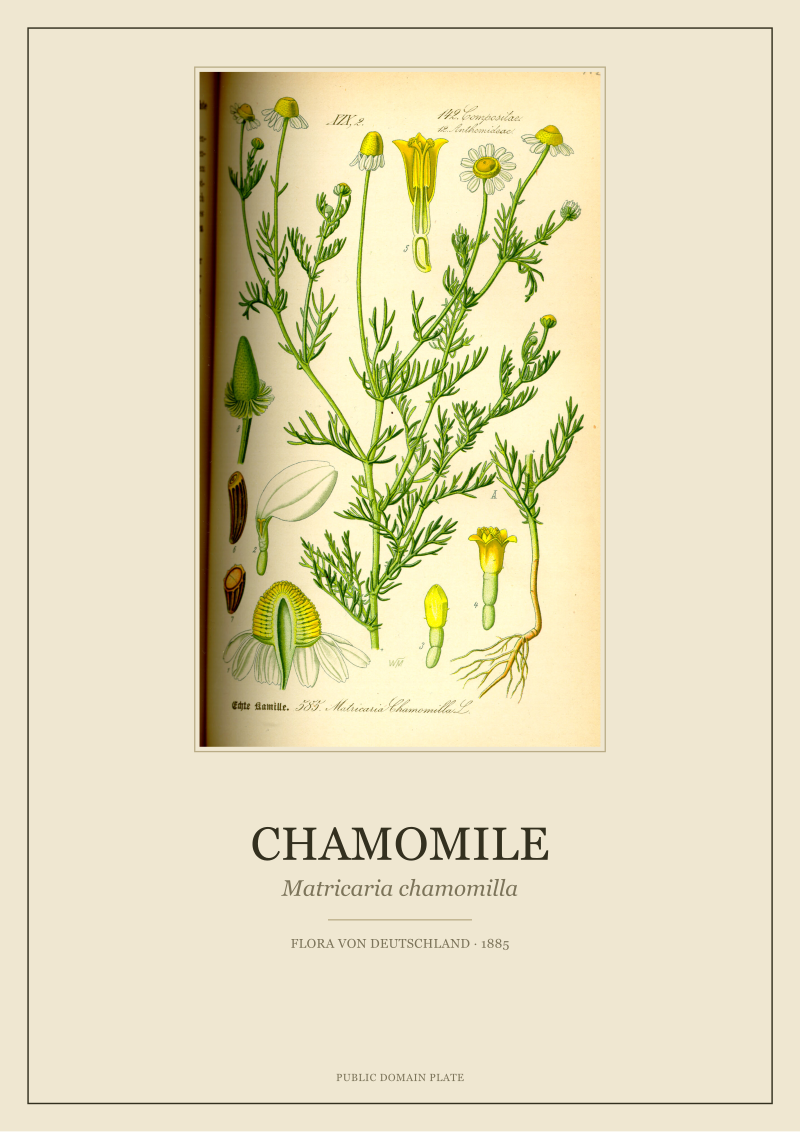 Chamomile
The print from this article · from €29.95
View the print →
FAQ
Why doesn't the Botanic Walls studio sell rose plates?
The studio restores O.W. Thomé's plates from Flora von Deutschland, Österreich und der Schweiz, published in 1885. Thomé's scope was the field flora of German-speaking Europe — chamomile, ivy, cornflower, fennel — not cultivated garden roses. We do not restore outside the Thomé corpus because the colour, paper and restoration decisions we make are calibrated to one lithographer and one printing house. A rose plate would be a different studio.
Which public-domain rose work is the "best" to print?
It depends on the room and the paper. Redouté's Les Roses (1817–1824) is the technical peak of hand-coloured stipple engraving and reads as painterly at A2. Willmott and Parsons's The Genus Rosa (1910–1914) is chromolithographic and reads more like a modern plate — flatter, bolder, denser colour. Gerard's 1597 woodcuts are historically fascinating but structurally refuse enlargement past A4 without the hatching turning into a graphic pattern.
What is the difference between a public-domain scan and a restored plate?
A public-domain scan is a legal object: the copyright has lapsed and the file is free to use. A restored plate is a visual object: a scan that has been corrected for colour drift, cleaned of foxing and library marks, deinterlaced from facing-page bleedthrough, and output at a resolution that holds at the chosen print format. Many free rose scans look adequate on a screen and fall apart printed above A3.
How much should an A2 rose print realistically cost in 2024?
In the United Kingdom, a reasonable A2 giclée print on 300 gsm cotton rag paper runs £35–£70 depending on the printer. A hardwood frame with conservation glass runs £90–£190 at that size. The restored file itself, if it has been worked on properly, is £20–£50. All in, a wall-ready A2 rose print you would not wince at lands roughly in the £180–£250 range before delivery. Below that, something has usually been skipped.
Why do old rose plates often look pink on screen but orange when printed?
Scanners read reflective paper differently from the way a human eye does, and historical pigments — particularly the carmines and crimsons used in nineteenth-century hand-colouring — shift under different light sources. A plate scanned under tungsten and displayed on an uncalibrated monitor can look convincingly rose-pink and then print as salmon or terracotta on a modern inkjet. A properly restored file is corrected against physical colour references, which is where most of the invisible studio work goes.
Is any of this an argument against printing roses from free sources?
No. The free sources are a genuine public good, and for a reading-copy print on A4 paper taped above a desk they are entirely sufficient. The argument is only against the quiet mismatch between what the file can do and what the frame is asking it to do. A2 above a fireplace is a different ask from A4 above a laptop. The cost difference between the two outputs is where honest pricing has to live.
What about Ellen Willmott — is The Genus Rosa practical to print from today?
It is possible but awkward. Only a few hundred complete copies of The Genus Rosa were ever produced, and scans of the Parsons plates vary considerably in quality across the holding libraries. The Biodiversity Heritage Library hosts at least one full run, but the colour calibration between plates is inconsistent, and plate-by-plate restoration work is usually needed before the file prints convincingly at A2 or larger. The Willmott roses reward the effort; they do not forgive skipping it.
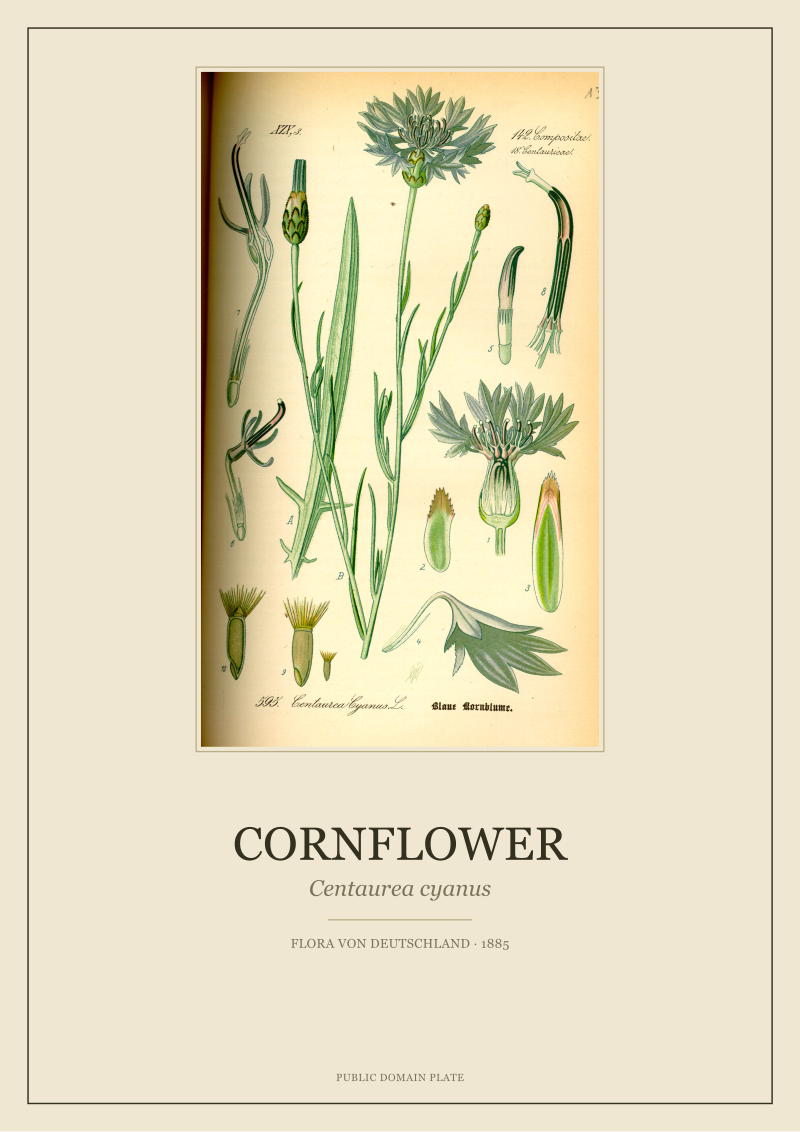 Cornflower
The print from this article · from €29.95
View the print →

New plates from the archive and 10% off your first print.
One email now with your code. No noise after.