This is the question we get most weeks, usually by email, usually with a phone photograph of an empty wall attached. So we will answer it the way we answer it in the studio: as a flowchart in prose. Three questions, asked in order, each one narrowing the arrangement before the next one is asked. The plates in front of us are the 1885 chromolithographs from O.W. Thomé's *Flora von Deutschland, Österreich und der Schweiz* — chamomile, common ivy, cornflower, fennel — restored plate by plate. The questions below are the ones we ask before a single nail goes in.
Question 1: How Big Is the Wall You Are Actually Working With?
Measure the wall before you measure anything else. Not the room, not the sofa in front of the wall, not the doorway to the left of it — the wall. Width and height in centimetres, and then subtract whatever the eye already reads as "not wall": a light switch, a thermostat, the top of a chair rail, the arm of a sconce that swings out. What you are left with is the usable rectangle, and that rectangle decides more than any other single fact about the arrangement.
We treat 120 cm of usable width as the fork. Below that number, a gallery wall in the traditional sense stops being a gallery wall and starts being a stack. Above it, you have room to breathe, to let plates converse, to leave a margin between the outermost frame and whatever architecture bounds the wall on either side. The number is not sacred — a narrow hallway with 90 cm of usable width can still carry a beautiful vertical run of two or three plates — but it is a useful line to draw before the arithmetic gets complicated.
If Yes (the wall is 120 cm wide or wider)
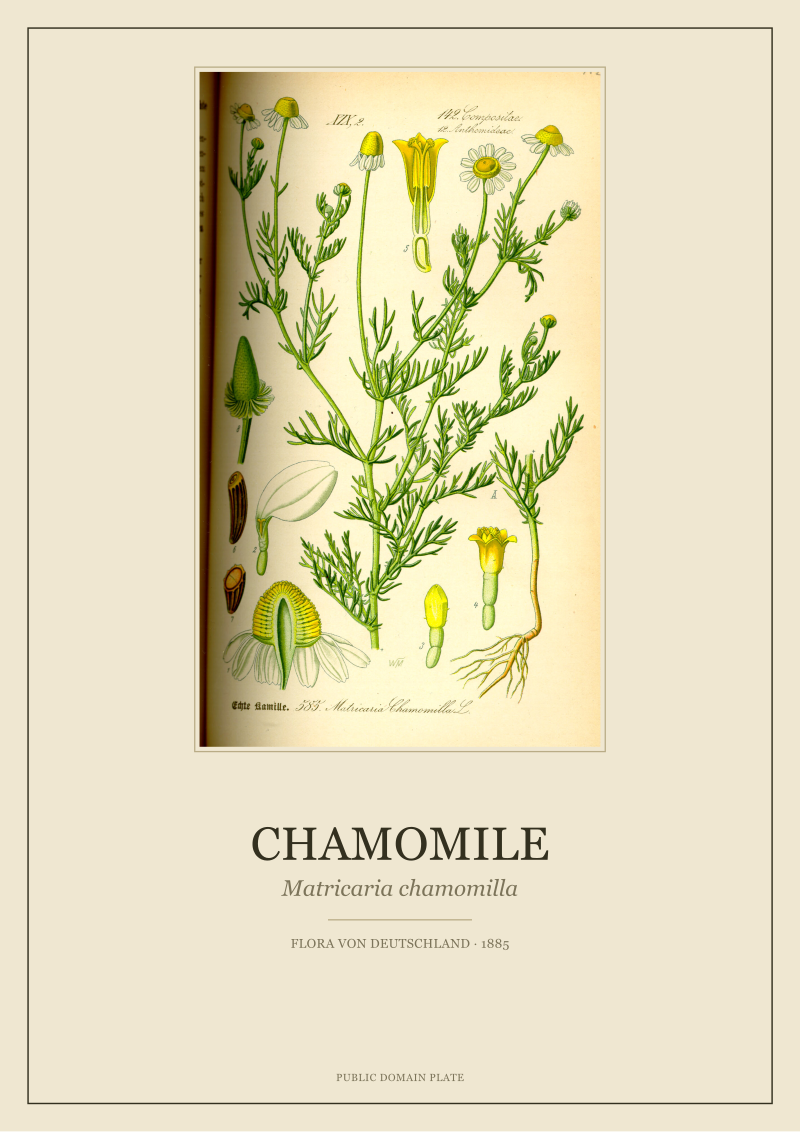
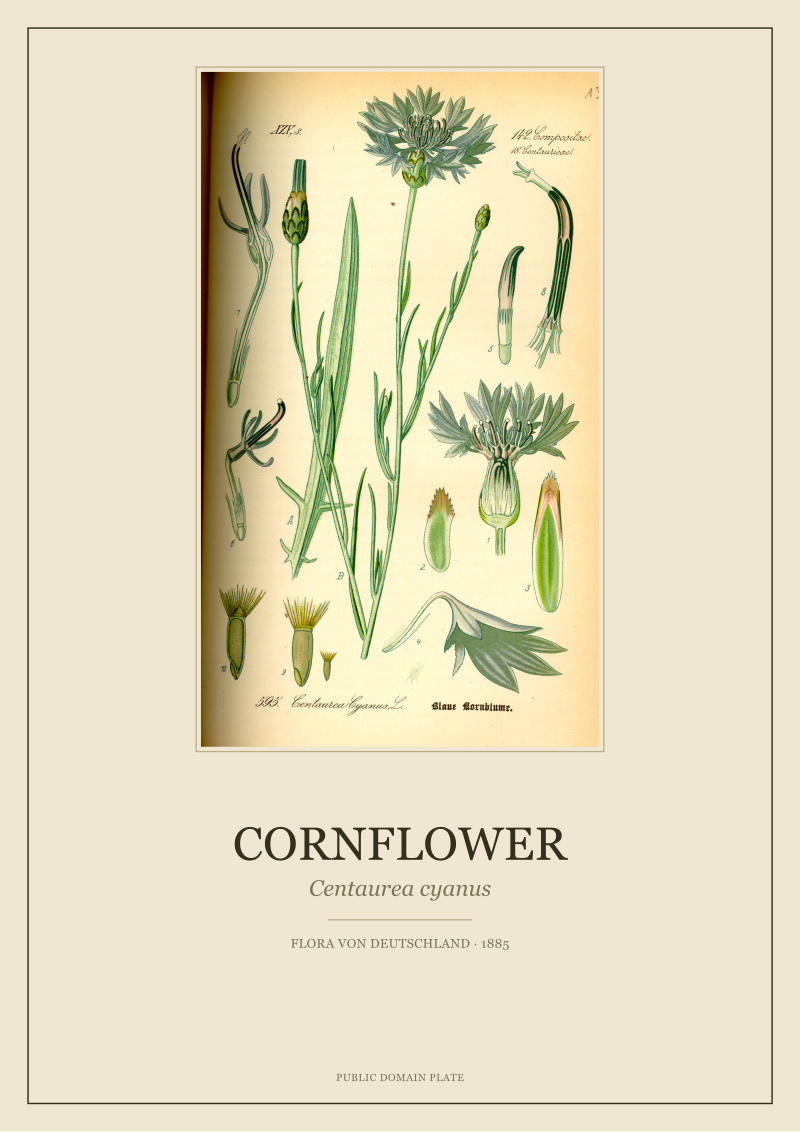
You have a proper canvas. This is the case where the classic grids and salon-style hangs earn their reputation. A 120–160 cm wall will hold four plates in a two-by-two grid comfortably, with 6–8 cm between frames and roughly 20 cm of margin on either side. A wall of 180 cm or more starts to invite asymmetry — a three-plus-one arrangement, or a horizontal run of four across at eye level, or the beginnings of a proper salon wall where the largest plate anchors the composition and smaller ones cluster around it. The chamomile plate, with its dense sprig of white ray florets, tends to read as anchor in our own installations; the cornflower, lighter across the page, floats better on the periphery.
If No (the wall is narrower than 120 cm)
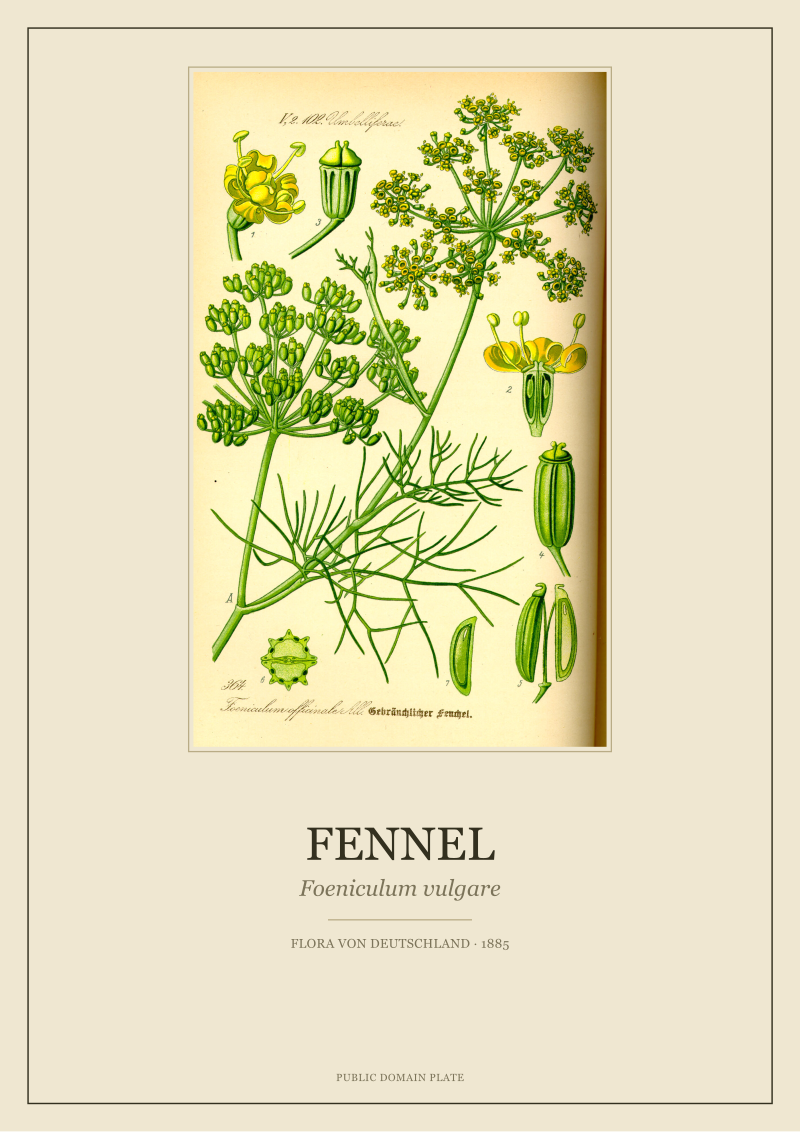
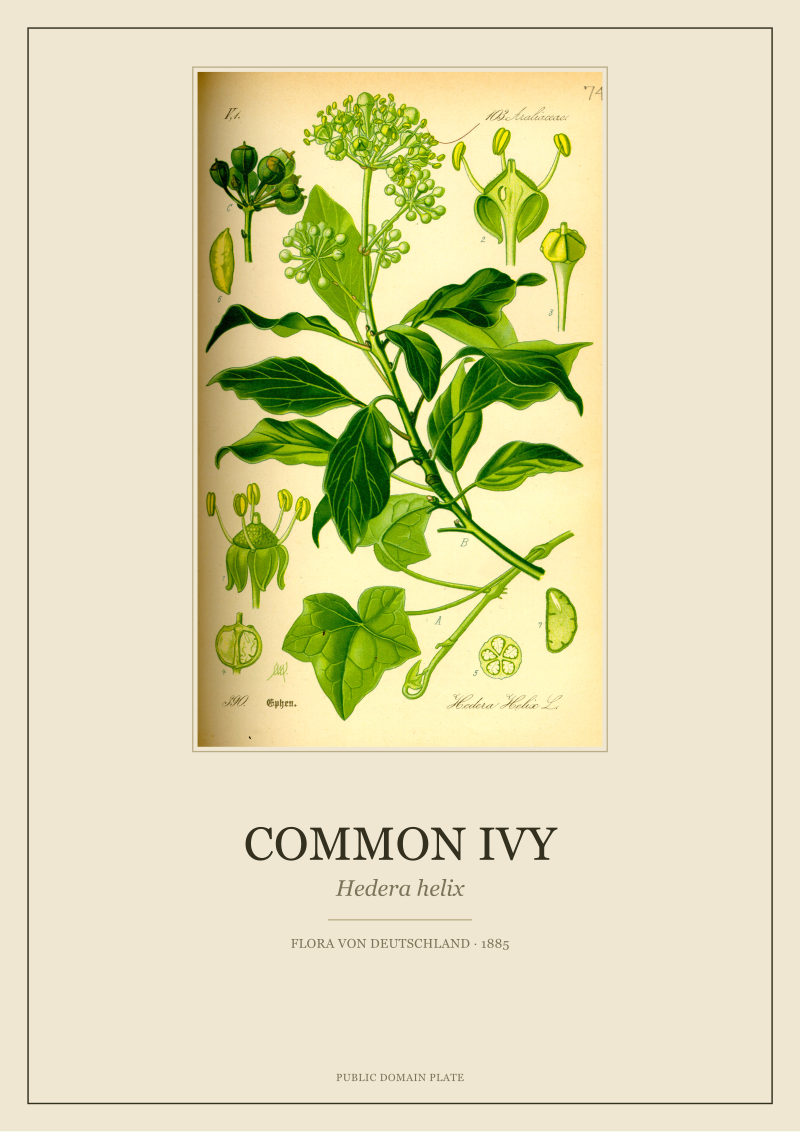
Go vertical. A stack of two or three plates aligned on a shared centre line will do more for a narrow wall than any attempt to squeeze a grid into it. Keep the frames identical in width — the eye reads a vertical column as an object only when its edges align — and let the plates themselves supply the variation. Common ivy, which Thomé drew climbing in long trailing tendrils, is a natural fit for the top of a vertical stack; the horizontal composition of a fennel plate, with its umbels spreading sideways, tends to sit better below than above. If the wall is truly small — under 90 cm, say, above a hallway console — one plate at correct eye height beats three plates crowded together every time.
Question 2: How Many Plates Do You Own (or Plan to Own)?
The second question is inventory. How many plates you have — or, if you are still building the wall, how many you honestly intend to buy in the next twelve months — changes the geometry more than most people expect. Three plates is a triangle. Four is a rectangle. Five and above starts to want a governing shape, either a grid that closes on itself or a salon composition organised around a dominant piece. Six is where an amateur wall starts to look like a considered one; nine is where it starts to look like a room.
The trap is the middle number. Two plates on a wide wall look lonely; five plates in an asymmetric hang can look accidental if the sizes are too similar. We are not against odd numbers — three works, seven works, nine works — but the arrangement changes shape at each count, and the wrong shape for the count is what makes a gallery wall read as unfinished.
If Yes (you have four or more)
You have enough for a grid, and a grid is the friend of any restored plate that already carries strong internal structure. The four Thomé plates we work with most often — chamomile, ivy, cornflower, fennel — cohere as a two-by-two grid because they share a common visual language: the same botanical Latin at the base of each plate, the same style of stippled root system, the same 1885 palette of muted green and paper cream. Hang them with identical frames, identical mats, identical spacing, and the grid becomes a single object rather than four smaller objects fighting for attention.
If you have six or more, a three-by-two grid holds its geometry on any wall of 160 cm width or more. Beyond nine plates, the wall becomes a salon and the rules change again — we treat salon hangs as a separate craft, one we address in a different article.
If No (you have three or fewer)
Do not force a grid. Three plates hung in an asymmetric triangle — one large plate slightly high and to the left, two smaller plates stepping down to the right — will always read better than three plates lined up in a strict horizontal row. If you have two plates, hang them as a vertical pair on the shared centre line described above, or side by side at true eye height with no more than 8 cm between frames. If you have one plate, hang it alone and do not apologise for it: a single well-restored botanical plate, correctly framed and correctly lit, is a portrait, and portraits sit better in solitude than in company.
 Chamomile
The print from this article · from €29.95
View the print →
Chamomile
The print from this article · from €29.95
View the print →
Question 3: What Is the Room Doing When Nobody Is Looking at the Wall?
The third question is the one people forget, and it is the one that most often decides whether a gallery wall reads as considered or as decorative. What is the room actually for? A gallery wall in a dining room is looked at, from a fixed distance, for the length of a meal; it can carry more density and more visual noise than a wall in a bedroom, which is glanced at in low light and read most often when the eye is tired. A gallery wall behind a sofa is seen from below and at close range; a gallery wall at the end of a hallway is seen head-on from ten metres away and needs to hold up as a single silhouette long before the individual plates come into focus.
The fork here is between rooms where the wall is looked at deliberately and rooms where the wall is lived alongside. Kitchens, dining rooms, formal entryways, studies: deliberate. Bedrooms, living rooms with television as their focal point, hallways, children's rooms: alongside. The distinction is not about grandeur — it is about attention.
If Yes (the room is looked at deliberately)
Push the density up and the frame weight forward. In a dining room, four plates in a tight two-by-two grid, framed in dark wood or a matte black, will hold the wall through a two-hour dinner without exhausting the eye. In a study or a working library, a five- or six-plate salon hang gives the room something to sit with during the pauses in the work. This is the setting where the chamomile plate earns its keep — up close, the ray florets read as individual painted marks, the way a Dutch flower painting rewards close inspection. Choose plates that will hold at 40 cm as well as at 4 m.
If No (the room is lived alongside)
Ease off. In a bedroom, in a living room, in a hallway seen mostly in passing, a lighter density will age better. Two or three plates in pale frames — natural oak, warm ash, an unpainted wood that recedes into the wall — will register as a considered arrangement without demanding attention every time you cross the room. Common ivy suits this register particularly well: it is a familiar plant, a wall-crawler by nature, and its drawn version carries some of the same quiet as the living one. Cornflower does similar work in a bedroom that gets morning light, where the pale blue of the ray florets warms up as the sun climbs.
If You Answered Everything: The Routing Table
The three questions yield eight possible answer combinations, and each one points to a different arrangement. The table below is the one we work from in the studio.
| Q1: Wall ≥ 120 cm? | Q2: Four or more plates? | Q3: Deliberate room? | Recommendation |
|---|---|---|---|
| Yes | Yes | Yes | Two-by-two grid, dark frames, tight 6–8 cm spacing, dining or study wall. |
| Yes | Yes | No | Two-by-two grid, pale oak frames, 8–10 cm spacing, softer bedroom or hallway. |
| Yes | No | Yes | Asymmetric triangle of three, mixed frame widths, anchored by the largest plate. |
| Yes | No | No | Horizontal row of two or three at eye level, pale frames, generous margins. |
| No | Yes | Yes | Vertical stack of three or four aligned on centre line, dark frames, hallway. |
| No | Yes | No | Two-plate vertical column in a narrow bedroom nook, pale frames, quiet register. |
| No | No | Yes | Single plate at true eye height, dark frame, museum-style solitary hang. |
| No | No | No | Single plate, pale frame, hung slightly low above a console or headboard. |
Read the table as a starting position, not a verdict. Every wall carries its own oddities — a radiator that eats the bottom 30 cm, a ceiling that slopes, a window that throws hard afternoon light onto one half of the composition — and every plate carries its own weight. The four Thomé plates we know best behave differently on the same wall: chamomile anchors, ivy trails, cornflower floats, fennel spreads. The routing table gets you to the right shape; the plates themselves decide the final arrangement, and that decision is often made only after they are propped against the skirting board in the actual light of the actual room.
If you are building a wall from restored 1885 plates and want to see the four species discussed here in their studio-restored form, they live at our shop alongside the rest of the current Thomé restorations.
 Cornflower
The print from this article · from €29.95
View the print →
Cornflower
The print from this article · from €29.95
View the print →
Closing: What This Piece Did Not Cover
Three things we deliberately kept out of this decision tree, because each deserves its own article rather than a paragraph in someone else's. This piece did not cover framing itself — the choice between float mount and window mat, the case for museum glass over standard glazing, the mathematics of frame width relative to plate size. Framing is a fifty-page argument, not a footnote. This piece did not cover lighting: picture lights, wall washers, the difference between 2700 K and 3000 K in a room with warm walls, the question of whether to light a botanical plate at all versus letting ambient daylight do the work. Lighting changes the perceived colour of a chromolithograph more than most people realise. And this piece did not cover mixing eras — hanging an 1885 Thomé plate beside a contemporary botanical print, or beside a 17th-century Dutch flower engraving, or beside a photograph. That is a conversation about visual grammar, and it belongs somewhere the grammar can be laid out properly.
FAQ
How high should the centre of a botanical gallery wall sit?
The museum standard is 145–150 cm from the floor to the centre of the composition, measured to the visual midpoint of the whole arrangement rather than to any single plate. In a dining room where the wall is read while seated, drop the centre to 135–140 cm. Behind a sofa, the bottom edge of the lowest frame should sit 15–25 cm above the sofa back — the centre of the arrangement then follows from the shape of the hang, not from a fixed number.
Should all the frames match, or is mixing frames acceptable?
For grids, match. Identical frames turn four plates into a single visual object, which is what a grid is for. For asymmetric triangles and salon hangs of five or more, mixing frame widths and finishes is not just acceptable but often necessary — a large anchor plate can carry a heavier frame, while satellite plates around it can sit in lighter mouldings. The rule that matters is consistency of temperature: warm wood with warm wood, cool black with cool black. Do not mix warm oak with cool ebony on the same wall.
Do restored 1885 plates need special glazing?
Chromolithographs from Thomé's era were printed on paper made to different standards than modern acid-free stock, and the surviving originals are handled by conservators. Our studio-restored versions are printed on archival paper and behave like any modern giclée in that respect — standard picture glass or acrylic is fine for most rooms, and museum-grade UV-filtering glass is worth the cost only if the wall gets several hours of direct sunlight per day. The plate itself does not require it; the room decides.
What spacing between frames looks right for a grid of botanical plates?
Between 6 cm and 10 cm, measured frame edge to frame edge, works for almost every plate size we sell. Tighter than 6 cm and the individual plates start to lose their identity; wider than 10 cm and the grid stops reading as a single object. For a two-by-two arrangement of Thomé plates in standard studio frames, we default to 7 cm. If the frames are wider than 3 cm in profile, add a centimetre; if narrower, take one away.
Can a gallery wall of botanical plates work in a small bathroom?
Yes, with two caveats. Humidity is the enemy of paper, so any bathroom without an extractor fan or a window is a bad candidate — the plates will cockle inside their mats within a season. Given adequate ventilation, a vertical stack of two or three small plates above a basin or beside a mirror works beautifully; the enclosed scale of a bathroom suits the intimate register of botanical illustration. The common ivy plate, in particular, reads well in a bathroom because the plant itself is at home in damp corners.
Is it worth building a gallery wall around a single species theme, or should I mix?
Both approaches work, and they do different things. A single-species wall — four plates of ivy at different growth stages, say, or four plates of chamomile from different flora — reads as a study, close to how a botanical print might have been hung in a 19th-century schoolroom. A mixed wall of contrasting species — chamomile, ivy, cornflower, fennel together — reads as a garden, or as a page torn from a herbarium. The single-species wall is quieter and more scholarly; the mixed wall carries more visual life. Neither is more correct.
How do I decide which plate is the anchor of an asymmetric arrangement?
Two tests. First, size: the largest framed piece is almost always the anchor by default, and fighting that default rarely improves the composition. Second, visual weight: some plates are simply denser than others regardless of frame size. The chamomile plate, with its packed cluster of flowers and dark central discs, carries more weight than the cornflower plate at the same dimensions. When size and visual weight point to the same plate, hang it slightly off-centre and let the rest of the arrangement cluster toward it.
Do restored botanical plates lose value if I hang them in direct sunlight?
The originals do — 19th-century chromolithographs will fade meaningfully under years of direct sun, which is why museum reading rooms are dim. Modern archival prints of restored plates are more resistant, but they are not immortal. Pigment inks on cotton-rag paper will hold their colour for decades in indirect light and begin to shift after five to ten years of daily direct sun. If the wall you have chosen gets hard afternoon light, budget for UV-filtering glazing or accept that the plates will eventually need to be reprinted.
New plates from the archive and 10% off your first print.
One email now with your code. No noise after.