How did a set of four plates from a German teaching flora end up as the default answer to "botanical print sets for wall art"? The short answer is a chain of custody that runs from Otto Wilhelm Thomé's signature in 1885 to a flatbed scanner in a European library a century later to the studio desk where we are writing this. The longer answer is that the Chamomile, the Common Ivy, the Cornflower and the Fennel in our catalogue — all from Thomé's *Flora von Deutschland, Österreich und der Schweiz*, all public domain — were not designed as wall art, and understanding why matters before you hang them.
1885: Thomé Signs Off on a Schoolbook That Will Outlive Him
The year on the plate is a date of publication, not a date of invention. By 1885, Otto Wilhelm Thomé had been teaching natural science to German schoolchildren for more than two decades, and the project that bore his name — *Flora von Deutschland, Österreich und der Schweiz* — was conceived as a working flora for the classroom, not a decorative monument. The plates were drawn, lithographed and bound to be opened on a desk, pointed at with a chalk-dusted finger, and closed again at the end of a lesson.
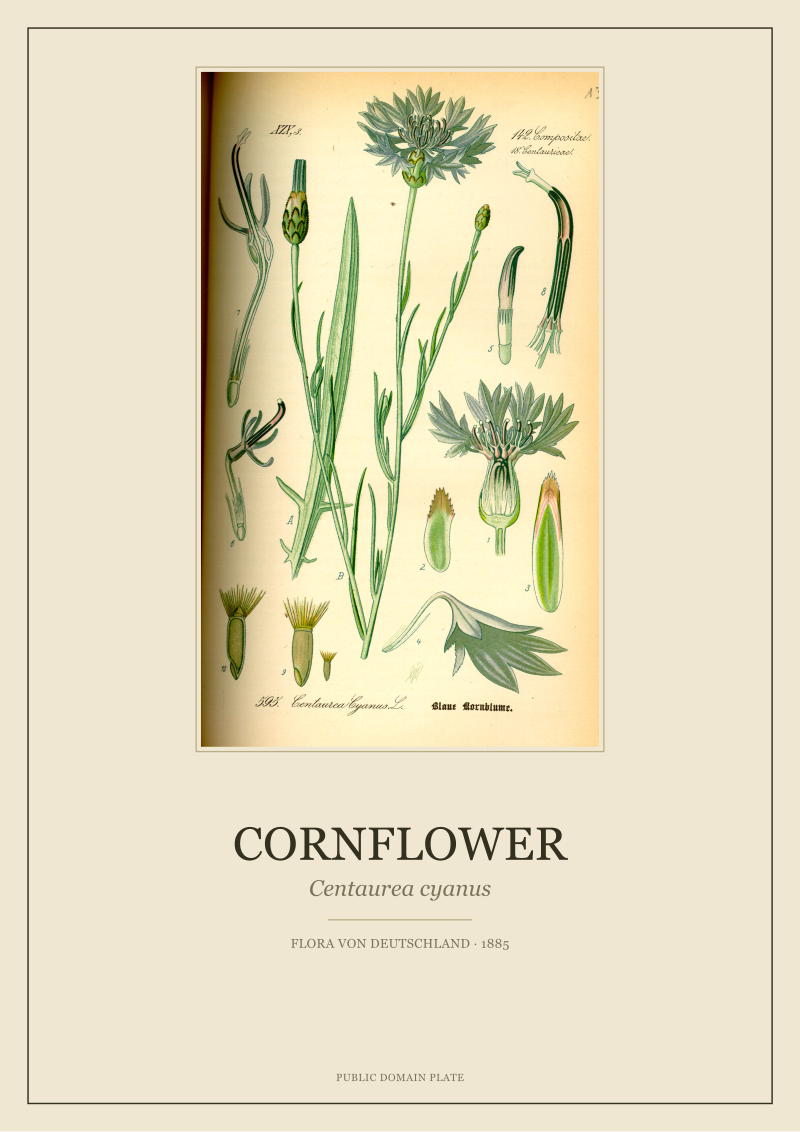
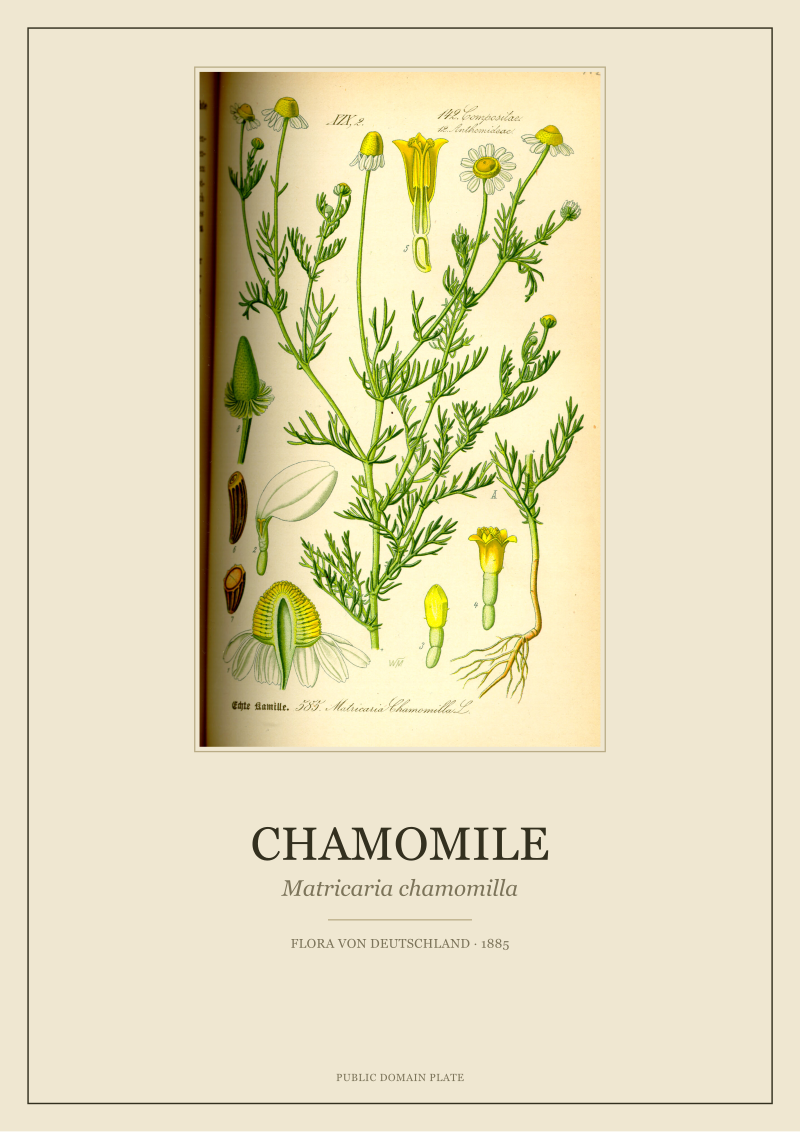
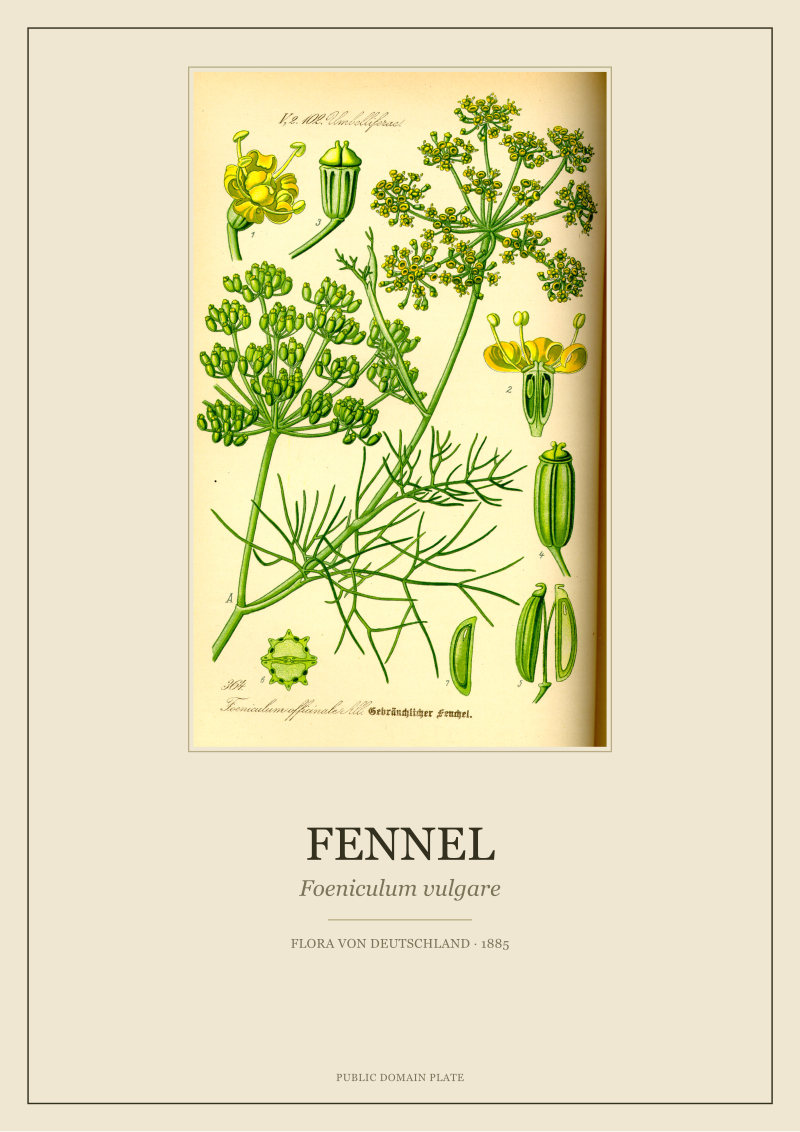
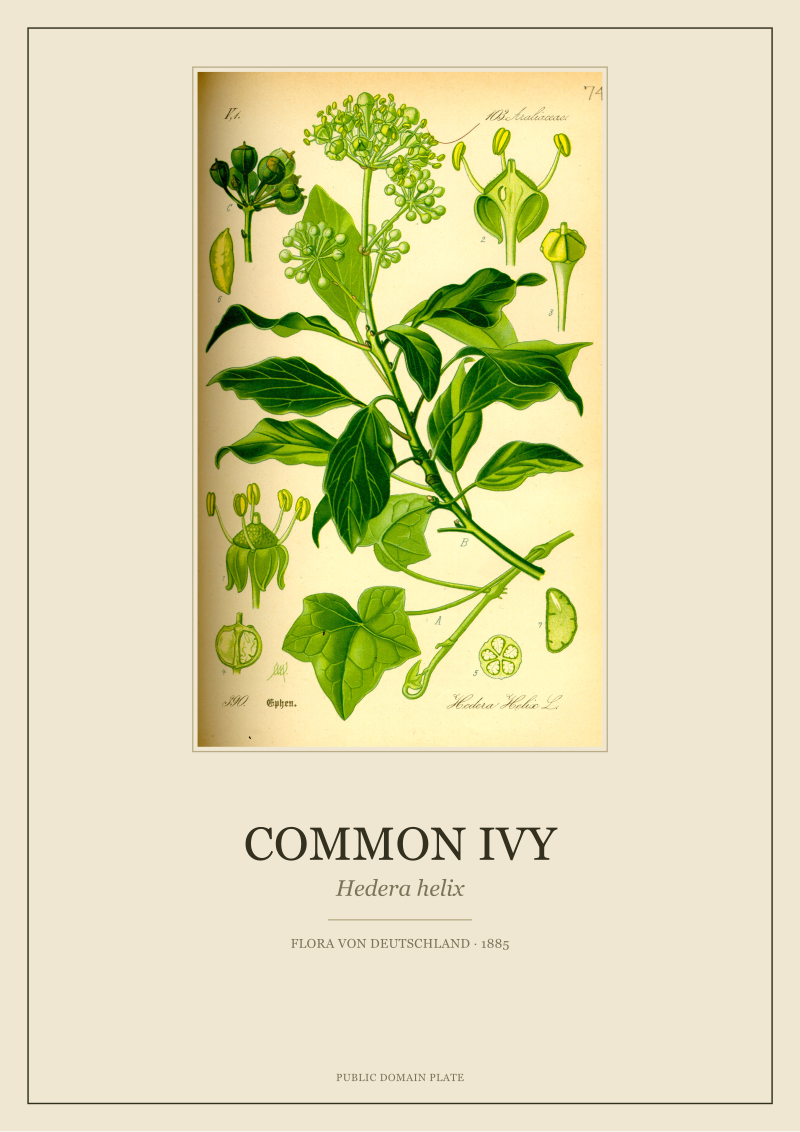
That functional origin is visible in every one of the four plates we restore. The Chamomile (*Matricaria chamomilla*) is drawn with the full plant and a dissected floral head, because a pupil needed to count the ray florets and understand the hollow receptacle that distinguishes it from its many lookalikes. The Fennel (*Foeniculum vulgare*) shows the compound umbel and the feathery leaf in the same frame, because the identifying signature of the Apiaceae is the umbel, not the smell. The Common Ivy (*Hedera helix*) is shown both in juvenile climbing leaf and in the rarer mature flowering form, because many a 19th century botanist had been embarrassed by thinking they were two different plants. The Cornflower (*Centaurea cyanus*) is drawn with the stem and ligulate ray flowers precise enough that you could key it against a weed in a wheat field without the plate in hand.
None of this is wall-art logic. It is pedagogical logic. Thomé signed off on a schoolbook, and the schoolbook outlived him.
1909: The Plates Enter the Public Record and Begin Their Second Life
The plates were not wall art in 1885 and they were not wall art in 1909 either, but the second date matters because by then the first wave of library deposits, reprints and institutional acquisitions had made Thomé's flora a public record rather than a private commercial object. A plate reproduced in a classroom in Vienna, catalogued in a university library in Leipzig, and reissued in regional printings across Austria-Hungary has, by the first decade of the 20th century, left the author's desk entirely. It belongs to the record of German-language botanical teaching.
This matters for a reason that is dull but structural: public-domain status under modern copyright regimes is calculated from the author's death plus a term of years, and Thomé's work entered the uncontested public domain long before any of this century's scanning projects began. By the time Google Books, the Biodiversity Heritage Library and various European national libraries started photographing bound floras in the late 1990s and early 2000s, there was no rights-holder standing between the plates and anyone with a flatbed scanner and a weekend.
The second life of the plates begins here, in the slow 20th century — not with a dramatic rediscovery, but with the ordinary administrative fact that enough physical copies were deposited in enough libraries that no fire, no war and no bankrupt publisher could erase them. The Chamomile, the Ivy, the Cornflower and the Fennel in our catalogue descend directly from this invisible provenance work done by librarians who never thought anyone would hang their holdings on a wall.
 Cornflower
The print from this article · from €29.95
View the print →
1998: The First Flatbed Scans Go Online, Flaws and All
The late 1990s and early 2000s were the first time the plates in Thomé's flora reached a general audience in digital form, and the honest word for the result is: rough. Flatbed scanners of that generation handled bound books badly. The gutter of a hardcover flora cannot sit flat without being pressed, and pressing a 19th century binding damages it, so the scans were made with the book tented open, which meant the inner edge of every plate curved into shadow and lost line detail. Illumination was uneven. Colour balance was set by whoever happened to be at the console, often with no reference target, so a Chamomile scanned in Munich and the same plate scanned in Berlin could end up with the yellows a full step apart.
There was also the paper itself. By 1998, the physical copies being scanned had been handled for over a century. Foxing — the brown spots caused by iron impurities and fungal growth in old paper — was present on nearly every surviving plate. Some sheets had been dampened, warped, or rebound with modern end-papers that cast odd colour onto the scan. Several of the plates we work with today still carry visible pencil marginalia from a specific 1920s student who annotated her copy in a legible hand, which is charming on the physical object and unhelpful on a wall.
The scans that went online in this period are the ones you still find circulating freely today — on Wikimedia Commons, on digitised library sites, on the long tail of "free botanical prints" aggregator pages. They are legally reusable. They are also, almost without exception, not finished images. They are source material. The confusion between a 1998 flatbed scan and a usable print is where most of the badly produced "botanical print sets" on the market today begin.
2019: The Studio Opens, and the Restoration Argument Begins
Botanic Walls opens as a working studio in 2019, and the first internal argument — one we have revisited often enough to put it in writing — is what restoration of a 1885 plate actually means. There is a lazy version in which you take a 1998 scan, run an automatic contrast curve and a sharpening pass, call the yellows warmer, and sell it as "restored". There is a more defensible version where every mark on the plate is interrogated: is this foxing, is this a printing artefact, is this a pencil annotation, is this a bruise in the paper, or is this a line Thomé's draughtsman drew on purpose?
The studio takes the second view, which is slower and occasionally unflattering to the finished object. The Common Ivy plate, in particular, taught us this lesson early. The juvenile leaves on the lower half of the plate are drawn with a very fine stipple to indicate the matte surface of young ivy foliage. A naive sharpening pass reads the stipple as noise and smooths it away, producing a cleaner but botanically poorer print. The restored Ivy in our catalogue was built the opposite way: foxing identified pixel by pixel against the original lithographic texture, paper warp corrected without flattening the fibre, and the stipple protected as drawn information.
The Cornflower was easier technically and harder editorially. The 1885 blue is a specific chromolithographic blue, mixed from the pigments and plate chemistries available to Thomé's printer. A modern monitor can reproduce a far more saturated blue, and the temptation is to let it. We did not, and the Cornflower in our catalogue reads slightly more muted than the Instagram version of a cornflower you have in your head. That is intentional. The argument of the studio is that you are hanging an 1885 plate, not a 2026 photograph of a flower.
 Chamomile
The print from this article · from €29.95
View the print →
2026: What a Set of Four Looks Like on the Wall Today
In 2026, the four plates most frequently asked about together — the Chamomile, the Common Ivy, the Cornflower and the Fennel — hang well as a group not because they were designed to, but because Thomé's draughtsmen worked within a shared visual grammar across the entire flora. The sheets are the same proportions. The Latin names sit in the same place on each label. The line weight is consistent because the lithographic workshop was the same. Hung as a set, the four plates read as one editorial decision rather than four objects collected by accident.
The practical variables are honest ones. The dominant colour of each plate is different: the Chamomile is a cream and pale yellow, the Ivy a dense cool green, the Cornflower a muted blue against a dark stem, and the Fennel a lighter, more airy green with yellow umbels. On a warm wall — plaster, wood, warm paint — the set holds together. On a cool wall, the Ivy and the Cornflower advance and the Chamomile and Fennel recede, and we would advise widening the mats on the latter two to balance the eye. On a very dark wall, oak or dark green, the full set reads as four windows cut into the surface, and the labels become part of the composition rather than a footnote.
A set of four is also where a set stops being a pair and starts being a wall. One plate is an accent. Two is a pair, which the eye reads as a single statement. Three is awkward unless it is a triptych with a clear hierarchy. Four is a group, and groups scale: four plates in a 2×2 grid or in a horizontal row are two different arguments about the room, and the honest answer is that the grid reads as library and the row reads as frieze. The studio does not have a view about which is correct. The grid is more common because most rooms have more vertical wall than horizontal, not because grids are better.
The restored plates we hang today are the same four Thomé signed off on in 1885, which is the point. Nothing has been added. The restoration is in what has been carefully not removed.
What It All Means for Botanical Print Sets
The practical consequence of this chain — Thomé 1885, library deposits across the 1900s, flatbed scans in 1998, studio restoration from 2019, four plates on a wall in 2026 — is that the phrase "botanical print set" covers two very different categories of object that are usually sold at the same price point and sometimes labelled identically.
The first category is a 1998-era flatbed scan, upscaled, lightly auto-processed, printed on inkjet paper and sold as a set because four of them are cheaper to ship together. The foxing is still there. The gutter shadow is still there. The yellows are not the yellows of the plate. There is nothing illegal about this — the source files are public domain and reusable by anyone — and there is nothing fraudulent either, because no claim of restoration has usually been made. There is simply very little studio work between the scan and the frame.
The second category is a restored plate: the same public-domain source, but with the hundred years of handling damage and the 1998-era scanning compromises worked out one by one, and the botanical information that was on the original 1885 lithograph preserved rather than smoothed away. The Chamomile, Common Ivy, Cornflower and Fennel in our shop are the second kind. The difference between the two categories is not whether the plates "look nice" at thumbnail size, where both can look fine. The difference is what happens when you print them at wall scale, light them from the side, and look at them for five years.
If you are buying a set, this is the one question worth asking the seller: what did you do to the file between the library scan and the print? If the answer is "we restored it" without specifics, that usually means contrast and auto-sharpen. If the answer is a description of foxing removal, line protection and colour reasoning, you are looking at the second category of object. We would like to think our restored Thomé plates — all four of them, drawn by his draughtsmen in 1885 and still legible in 2026 — are the kind of thing that answers the question honestly. Our full set is available at /shop/, which is the only time we will mention it.
FAQ
What exactly is in a "botanical print set" when the source is Thomé's 1885 flora?
A set is a group of plates — most commonly four — lifted from the same 19th century teaching flora so that proportions, label position, line weight and lithographic workshop match across the group. In our case, that means the Chamomile (*Matricaria chamomilla*), Common Ivy (*Hedera helix*), Cornflower (*Centaurea cyanus*) and Fennel (*Foeniculum vulgare*) from Thomé's *Flora von Deutschland, Österreich und der Schweiz*. The visual coherence comes from the shared 1885 source, not from any later curation.
Are these plates actually in the public domain, or is that a marketing phrase?
They are genuinely in the public domain. Thomé's flora was published starting in the 1880s, and the author-death-plus-term calculations under European and most other modern copyright regimes placed the work firmly out of copyright long before any of the digital scanning projects of the late 1990s began. Anyone can legally reuse the source scans. What is not public domain is a specific studio's restoration work on top of those scans — but the underlying 1885 plates themselves are free to all.
Why do some "restored" botanical prints look so different from one another?
Because "restored" is an unregulated word. A 1998-era library flatbed scan is the common starting point for almost every print on the market, but what happens next varies wildly. One seller runs an automatic contrast curve and a sharpening pass in ten seconds and calls that restoration. Another seller spends hours separating foxing marks from original stippling, correcting paper warp without flattening fibre, and reasoning about chromolithographic colour. Both results are legal; only the second is restoration in any meaningful sense.
Should the four plates be hung in a grid or in a row?
Both are legitimate and the choice is about the room rather than the plates. A 2×2 grid reads as a library wall and works where you have more vertical than horizontal space, which is most rooms. A single horizontal row reads as a frieze and works above a long piece of furniture or along a corridor. The 1885 plates were drawn to the same proportions, so either arrangement holds together visually; the studio does not have a preferred answer.
Do the plates need special framing because they are historical?
No. Because what you are hanging is a modern archival print of a public-domain source, not the fragile 1885 original, standard high-quality framing is sufficient: acid-free matting, UV-protective glazing if the wall gets direct sunlight, and a frame depth proportionate to the sheet size. The historical weight is in the image, not in the physical print, so no climate case or museum glazing is required for ordinary domestic display.
Are these plates safe to display in rooms with children or pets?
As printed botanical art, yes — a framed print is inert. The question of plant toxicity is a separate historical note: common ivy and chamomile both appear in old apothecary records, and we mention this as history rather than guidance. The plates are documentation of 19th century botanical teaching; they are not plant-care instructions, and we do not offer medicinal, culinary or horticultural advice about the species shown.
How many plates make a "set" rather than just a collection?
In practical terms, four. One plate is a single accent on a wall. Two plates read as a pair and function as one statement. Three is difficult to balance unless it is deliberately composed as a triptych. Four is the smallest group that reads as a set rather than as an accumulation of individual objects, which is why most of our customers ask about the four Thomé plates together — Chamomile, Common Ivy, Cornflower and Fennel — rather than any three of them.
What has this piece not covered?
Three things, deliberately. It has not addressed the medicinal or culinary properties of chamomile, ivy, cornflower or fennel — we are a botanical art desk, not a herbalism site, and historical apothecary use is not efficacy. It has not covered framing hardware, hanging heights or picture-light wiring, which belong to interior design rather than restoration. And it has not compared Thomé's flora to the other great 19th century floras — Köhler, Sowerby, Curtis — each of which deserves its own argument on another day.
New plates from the archive and 10% off your first print.
One email now with your code. No noise after.