Type the question into any search bar and you will see the same answer stacked ten results deep: there are "around 600" botanical gardens in the United States. Some pages say 586. Some say "more than 1,000". A few, confidently, say 200. The number depends entirely on who is counting and what they decided to count — a fact the listicles skip over on their way to the affiliate link. We restore 1885 plates for a living, which is a different way of keeping a garden, and from that desk the question looks less like a tally and more like a definition problem dressed as a trivia one.
The Number Everyone Repeats
Open the top ten SERP results and you will see the figure drift from page to page like a game of telephone played by people who have never visited a herbarium. One well-trafficked travel blog says 586. A larger aggregator rounds it to "about 600". A gardening affiliate site, apparently feeling generous that quarter, writes "more than 1,000 botanical gardens, arboreta, and public gardens across America". A quieter academic page, cited less often because it is less fun to copy, says the figure of institutions meeting the formal professional definition is closer to 200.
They cannot all be correct. The honest answer is that each of those numbers is defensible against a different definition, and none of them is defensible against all of them. 586 is roughly the membership count of the American Public Gardens Association in a given year, give or take seasonal churn. "Around 600" is 586 with the rough edges filed off for readability. "More than 1,000" is what you get when you fold in arboreta, conservatories, campus teaching collections, and civic park gardens — most of which do not call themselves botanical gardens, because they are not. 200 is what you get if you insist on peer-reviewed scientific research as the entry criterion, and most of the pretty gardens tourists photograph fail it.
What the listicles do not tell you — because it would spoil the clean paragraph — is that none of these counts includes the paper gardens. Which is a problem, if you believe, as we do, that a dried specimen filed in 1885 and a living plant in a conservatory bed are two expressions of the same institution. The plates we restore were drawn, in many cases, from exactly such specimens. The counting problem is upstream of the plant.
What a "Botanical Garden" Actually Means (and Who Decides)
There is no federal registrar of botanical gardens in the United States. There is no license, no accreditation body with legal authority, no central ledger. There is instead a small clutch of professional associations — the American Public Gardens Association is the largest and most quoted — which maintain voluntary membership rolls. If you join, you are counted. If you do not, you are not. The roll is a membership figure. It has been dressed up as a national census because the sentence sounds cleaner that way.
The international reference definition most commonly invoked is from Botanic Gardens Conservation International, which asks for a documented plant collection, scientific record-keeping, labeling, and some form of public, educational, or research mission. A garden by that definition does the work of a small museum: it accessions, it labels, it keeps a database of what it holds and where that specimen came from. A rose garden maintained by a city parks department, however beautiful, usually does none of these things. The parks department does not call it a botanical garden. The listicle writer, needing one more entry to hit the number ten, often does.
The distinction matters. A botanical garden by the strict reading is a research institution with living plants. Many American gardens that would never pass that test still do real work — public education, horticultural trials, conservation of regional flora — and the strict reading can feel punitive if you have ever volunteered weekends at a civic rose bed. The honest position is to admit the term covers a spectrum, which is why the published counts range from 200 to over 1,000 depending on where you draw the line. Anyone who gives you a single number without disclosing the cutline is selling you confidence they have not earned.
For our purposes at the desk, the useful question is not "which gardens pass" but "which gardens keep the kind of records that make species like *Matricaria chamomilla*, *Hedera helix*, *Centaurea cyanus*, or *Foeniculum vulgare* traceable from plate to pressed specimen to living plant". The strict reading keeps the three in dialogue. The loose one loses the paper.
What the Count Leaves Out: Herbaria, Plates, and Paper Gardens
The counts you find online count beds. They do not count paper. This is where the trivia question starts to feel genuinely incomplete, because the botanical world's primary scientific archive is not the display garden — it is the herbarium, the climate-controlled room full of pressed, mounted, labeled specimens that a serious institution builds alongside its living collection. The United States holds several hundred herbaria across universities, museums, and research gardens. The New York Botanical Garden's herbarium alone holds in the vicinity of eight million specimens. These are not footnotes to the gardens; in historical terms, they are the gardens' spine.
Then there are the plate collections. The illustrated floras of the nineteenth century — Otto Wilhelm Thomé's *Flora von Deutschland, Österreich und der Schweiz*, published from 1885, chief among the ones we work with — were drawn from exactly those pressed specimens. A plate of chamomile is not a decoration. It is a scientific document that fixes what a given botanist, at a given moment, considered the diagnostic shape of *Matricaria chamomilla*: the pinnate leaves, the hollow receptacle, the ray florets curving back as the head matures. The same holds for the cornflower plate — *Centaurea cyanus* drawn with the pale bracts and the ragged blue florets a counting listicle will never describe. These images were made inside the same institutional ecosystem that produced the gardens. They are the gardens' publishing arm.
A honest count of "botanical gardens in the US" that respected the discipline would therefore have to decide: are we counting living collections only, or are we counting the full apparatus — herbaria, libraries, plate archives, seed banks, type-specimen vaults — that makes a garden more than a park? Nobody on the first page of Google is counting the full apparatus, because it would ruin the clean sentence. The number of American institutions that hold a serious herbarium is in the low hundreds. The number that hold significant historical plate collections — Thomé's folios, Curtis's *Botanical Magazine*, Redouté's lithographs — is smaller still, perhaps a few dozen major holdings scattered across universities and the largest gardens. None of this makes it into the "around 600" answer.
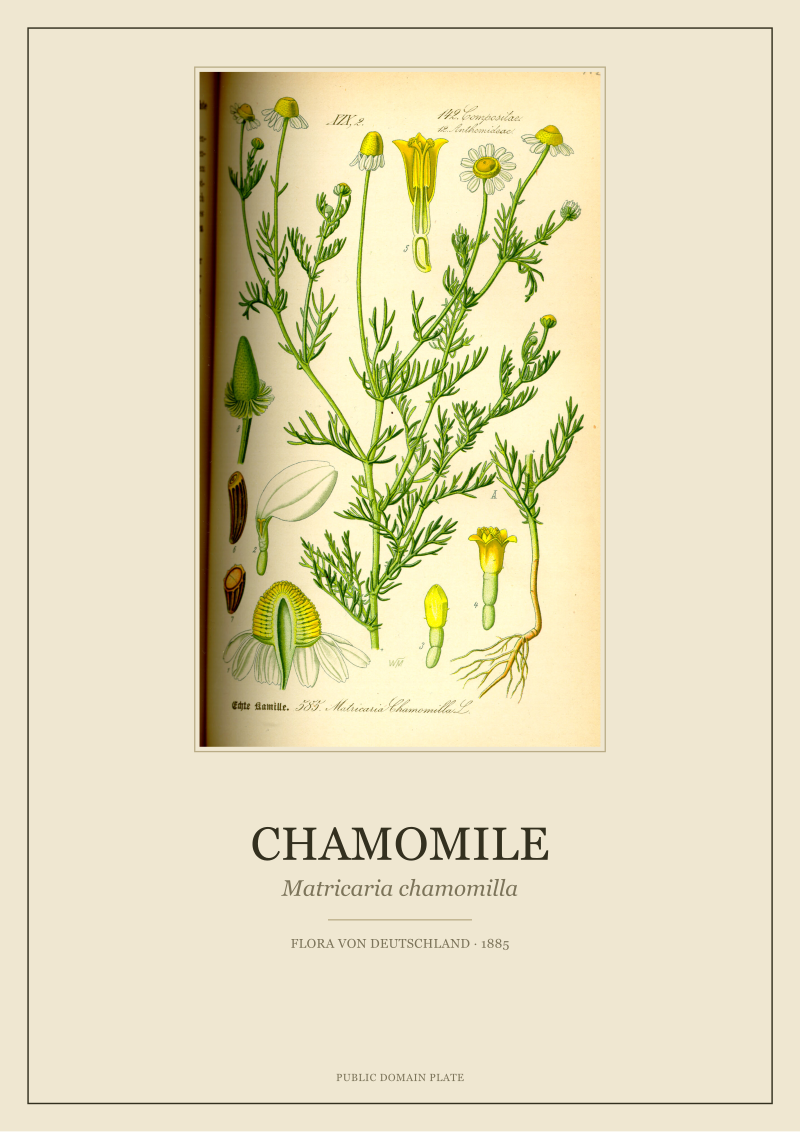 Chamomile
The print from this article · from €29.95
View the print →
Why This Matters If You Love Plants on Paper More Than in Pots
For readers who come to botany through the image rather than the trowel, the counting question has a quieter implication: the places that would show you *Hedera helix* drawn by a nineteenth-century hand, next to the pressed specimen it was drawn from, next to the living vine climbing an outside wall, are rarer than the "around 600" would suggest. They exist. They are magnificent when you find them. But the SERP that answers your question with a round number is not the SERP that will tell you which gardens still keep that chain intact.
The chain is the thing worth caring about. A plate from Thomé's 1885 flora is a single frame of a long film: the plant exists, the botanist presses and mounts it, the illustrator draws from the mount, the chromolithographer transfers the drawing to stone, the printed plate circulates in a schoolbook, the schoolbook sits for a century, and the plate — if it survives — becomes, in our studio and others like it, a restored image that goes back onto a wall. Every botanical garden that still runs a herbarium is a working frame of that film. Every one that has let its paper collection drift to a basement without climate control is a frame going dark.
The counting problem matters because it hides this. "Around 600 botanical gardens" sounds abundant. The real figure of institutions still doing the full scientific-and-visual work — accessioning plants, pressing specimens, labeling with care, maintaining historical plate archives and making them accessible — is small enough that each one is worth naming in a way the listicles never bother to. If you came to this piece hoping for a tidy number, we have failed you politely. If you came hoping to understand what the number is actually trying to describe, you now know why nobody who writes about it carefully gives you a single figure without caveats.
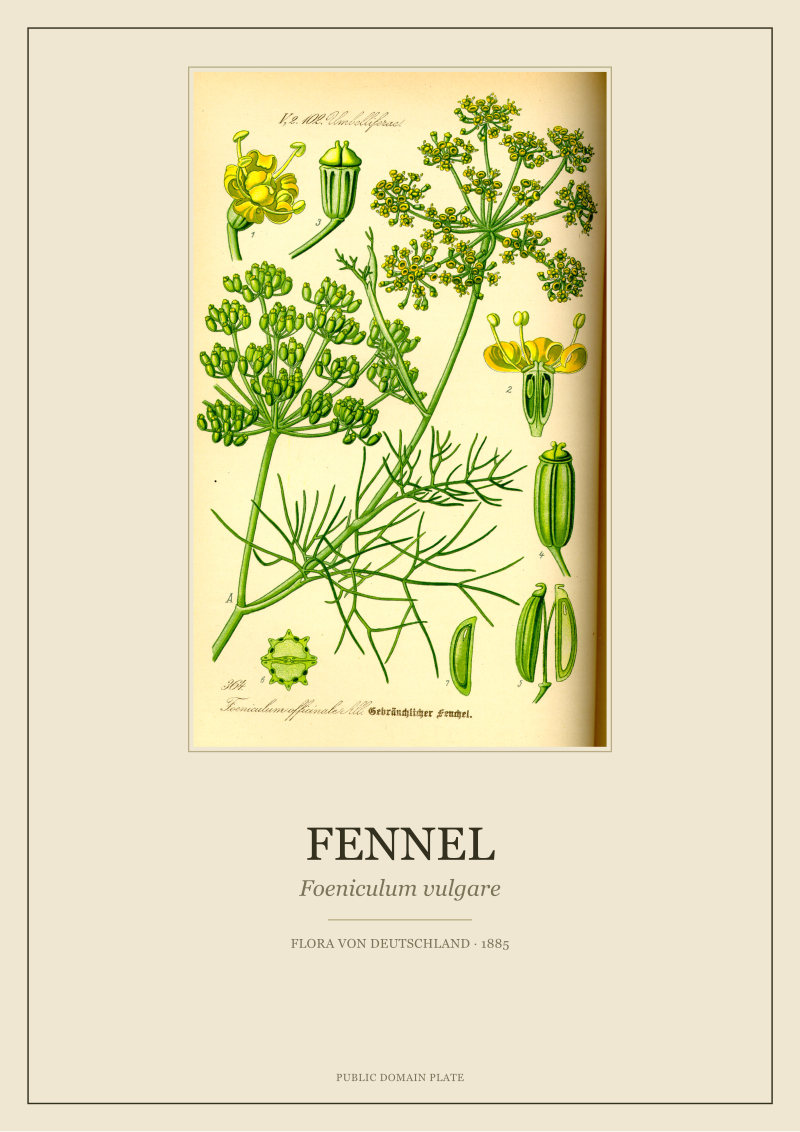
At our end of the operation, the counting question resolves itself. We work from the paper. A plate of fennel from 1885 — *Foeniculum vulgare*, drawn with the fine umbels and the thread-like foliage that let a botanist tell it from hemlock at a glance — is itself a garden, in the sense that any serious botanist from the period would have recognized. When we restore it, scan it, clean it of foxing and press-marks, and offer it on the studio shop, we are doing a cousin of the work the great American herbaria do with their pressed sheets. Different medium, same instinct: keep the specimen legible, keep the chain intact, do not lose the frame.
The next question is the one worth asking, now that this one has been answered honestly. If roughly 200 American institutions meet the strict scientific definition, and perhaps a few dozen hold historical plate archives of real depth, which ones are they, and which of them still let the public into the paper rooms? That is a different piece, and it is where the real work of looking at botanical art in America actually begins.
FAQ
Is there an official US government count of botanical gardens?
No. There is no federal registry, licensing body, or legal definition of what qualifies as a botanical garden in the United States. The commonly cited figures come from voluntary professional associations — chiefly the American Public Gardens Association — whose membership rolls are often repeated as if they were national censuses. Anyone citing a precise number without naming the source and the definition behind it is quoting a membership list, not an audit.
Why do different sources give wildly different numbers, from 200 to over 1,000?
Because they are counting different things. The low end (around 200) applies the strict international definition requiring a documented scientific collection, labeling, and research or education mission. The middle figure (around 586 to 600) reflects the American Public Gardens Association membership. The high end (over 1,000) folds in arboreta, conservatories, campus teaching gardens, and civic park gardens that most botanists would not classify as botanical gardens in the technical sense.
What is the difference between a botanical garden and an arboretum?
A botanical garden maintains a documented collection of living plants organized for scientific, educational, or conservation purposes, usually across many plant families. An arboretum does the same but restricts itself to woody plants — trees and shrubs. In practice many large institutions operate as both. The counting confusion arises because listicles routinely merge the two categories, inflating totals without flagging that an arboretum is a specific subset, not a synonym.
Does the count include herbaria and historical plate collections?
No, which is one of this piece's main objections to the standard count. Herbaria — the climate-controlled archives of pressed, mounted specimens — are the scientific backbone of a serious botanical garden, and the United States holds several hundred of them across universities and museums. Historical plate collections of nineteenth-century floras like Thomé's 1885 work are even rarer. Neither appears in the public-facing tally, though both are what distinguishes a research institution from a pretty park.
Which American botanical gardens hold significant historical plate collections?
A precise map is beyond the scope of a single answer, and the honest reply is that no single public inventory exists. The largest research gardens and university herbaria — those with established library programmes — are the likeliest holders of nineteenth-century folios including Thomé's *Flora von Deutschland* and comparable continental works. Access policies vary. If you want to see a specific plate in person, write to the institution's library before travelling; the collections are quieter than the display beds and often appointment-only.
Is Thomé's 1885 flora in the public domain?
Yes. Otto Wilhelm Thomé's *Flora von Deutschland, Österreich und der Schweiz*, first published in 1885, has long entered the public domain in the United States and the European Union. The original plates — including those of *Matricaria chamomilla*, *Hedera helix*, *Centaurea cyanus* and *Foeniculum vulgare* that we restore — can be lawfully copied, scanned, restored, and reprinted. The craft lies in the restoration, not in the licensing. Any studio claiming an exclusive copyright on the underlying plate itself is overstating its position.
Why does the counting question matter beyond trivia?
Because the number conceals a trend. A round figure of "around 600" sounds abundant and lets readers assume botanical culture in the United States is in robust health. The subset still doing the full scientific-and-visual work — pressing specimens, cataloguing, maintaining historical plate archives, letting the public touch the paper side of the work — is far smaller, and each institution within it is non-trivial to replace. The counting problem is a visibility problem, and visibility is the first stage of funding.
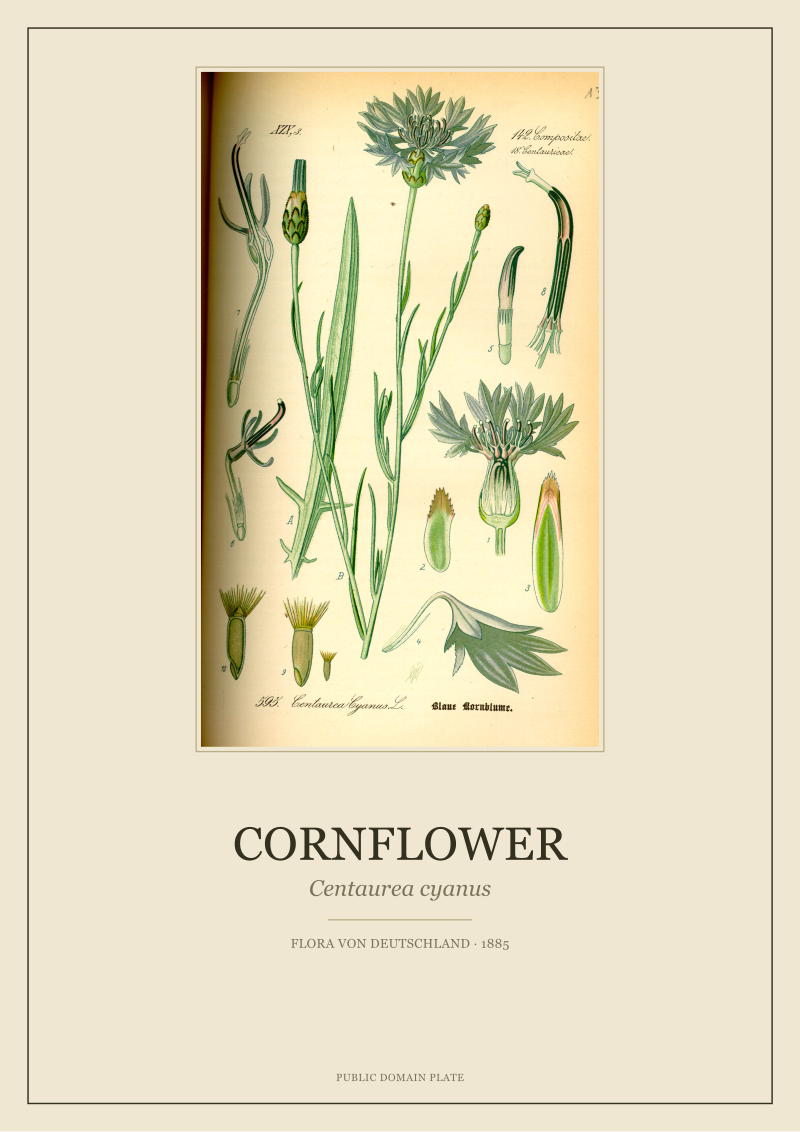 Cornflower
The print from this article · from €29.95
View the print →

New plates from the archive and 10% off your first print.
One email now with your code. No noise after.